Master of Science Materials Science

This page provides information for students of the programme M.Sc. Materials Science (also the related International Double Degree programmes) including important documents and forms for your studies.

New Study Regulations

Information given on this site refers to the new Study Regulations, that came into effect on 01 June 2024 and are thus binding for new students from the winter term 24/25 on.

Information on previous Study Regulations, which still apply for many other students, are available under Documents & Forms.

Documents and Forms

All documents and forms for students in the M.Sc. Materials Science including related Double Degree programmes are available here:

Documents and Forms – M.Sc. Materials Science

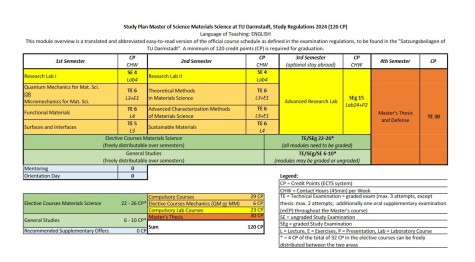
Your Study Plan (Study Regulations 2024)
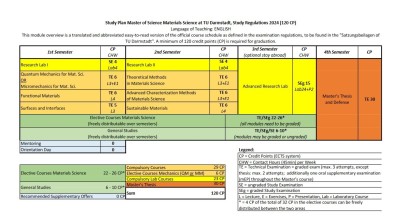
Study Plan M.Sc. Materials Science (Study regulations 2024). Click the graphic for a downloadable full-size view (PDF).

The M.Sc. Materials Science focuses on functional materials such as energy materials, magnetic materials, or electronic materials and their synthesis and characterization. Courses on theoretical materials science include quantum mechanics, non-equilibrium thermodynamics, and continuum mechanics.

There is a mandatory elective domain “Quantum Mechanics/Micromechanics” with a choice between the modules “Quantum Mechanics for Materials Science” and “Micromechanics for Materials Science.” The module not elected in this domain becomes part of the domain “Elective Courses Materials Science.”

The most important changes in the Study Plan as compared to the previous study regulations (from 2015) are as follows:

  • Additional compulsory course “Sustainable Materials” (6CP) and therefore, 6CP less in the elective section.
  • The “Advanced Research Lab” (15CP) now is a graded module and no longer a passed/not passed module. Therefore, the grade of the Master Thesis will no longer be counted twice.
  • An industrial internship is no longer required

Please note: Other/additional compulsory modules (conditions / adjustment courses) may be specified on your Letter of Admission.

It is recommended to choose your elective courses from one of the packages listed below. After consulting with one of our professors, you may also choose courses from other departments.

Here (PDF file) (opens in new tab) you will find an overview of all the modules offered.

Module Module title Credit points (CP)
11-01-2005 Fundamentals and Technology of Solar Cells 4
11-01-2008 Graphen and Carbon Nanotubes – from fundamentals to applications 4
11-01-2004 Materials Science of Thin Films 4
11-01-2026 Organic Functional Materials: From LCD to Molecular Circuits 4
11-01-8162 Semiconductor Interfaces 4
11-01-2035 Smart design and advanced processing of next-generation materials 4
11-01-2002 Soft Matter and Interfacial Phenomena 4
Total CP: 28
Module Module title Credit points (CP)
11-01-1630 Circular Materials 5
11-01-7300 Electrochemistry for Energy Applications I: Fundamentals 4
11-01-7301 Electrochemistry for Energy Applications II: Devices and Technology 4
11-01-2005 Fundamentals and Technology of Solar Cells 4
11-01-2023 Porous Ceramics for Energy-Related Applications 4
11-01-8162 Semiconductor Interfaces 4
11-01-4055 Seminar Research Topics in Materials Science 2
11-01-2035 Smart design and advanced processing of next-generation materials 4
Total CP: 31
Module Module title Credit point (CP)
11-01-8131 Engineering Microstructures 4
11-01-2024 Hysteresis in Magnetic Materials 4
11-01-2001 Magnetism and Magnetic Materials 4
11-01-2006 Mechanical Properties of Metals 4
11-01-4055 Seminar Research Topics in Materials Science 5
11-01-2035 Smart design and advanced processing of next-generation materials 4
11-01-2002 Spintronics 4
Total CP: 26
Module Module title Credit points (CP)
11-01-3029 Advanced Light Microscopy 4
11-01-9811 Characterization Methods in Materials Science: Neutrons and Synchrotron 4
11-01-2033 Current Topics in Physical Metallurgy – Seminar 2
11-01-8131 Engineering Microstructures 4
11-01-9063 Focused Ion Beam Microscopy: Basics and Applications 4
11-01-2017 In-situ Transmission Electron Microscopy 4
11-01-7982 Introduction to Scanning Electron Microscopy 1
11-01-7042 Materials Research with Energetic Ion Beams – Basic Aspects and Nanotechnology 4
11-01-2004 Materials Science of Thin Films 4
11-01-9332 Mechanical Properties of Ceramic Materials 4
11-01-2006 Mechanical Properties of Metals 4
11-01-9904 Rietveld Analysis of powder diffraction data 4
11-01-7060 Scanning Probe Microscopy in Materials Science 4
11-01-9062 Scanning Transmission Electron Microscopy 4
Total CP: 51
Module Module title Credit point (CP)
11-01-2037 Artificial Intelligence for Materials Science 6
11-01-7562 Computational Materials Science 5
11-01-8291 Density Functional Theory: A Practical Introduction 5
11-01-2027 Finite Element Simulation for Material Science 5
11-01-2031 Machine Learning for Materials Science 6
11-01-4109 Micromechanics for Materials Science 6
11-01-4108 Quantum Mechanics for Materials Science 6
11-01-3577 Thermodynamics and Kinetics of Defects 4
Total CP: 43
Module Module title Credit points (CP)
11-01-2030 Applied Fluoroorganic Chemistry: Synthesis, Functional Materials, Pharmaceuticals 4
11-01-1630 Circular Materials 5
11-01-2005 Fundamentals and Technology of Solar Cells 4
11-01-7292 Materials Chemistry 4
11-01-9332 Mechanical Properties of Ceramic Materials 4
11-01-2006 Mechanical Properties of Metals 4
11-01-0046 Non-conventional synthesis methods in materials chemistry 3
11-01-3031 Polymer Materials
6
11-01-3030 Polymer Processing 6
11-01-8162 Semiconductor Interfaces 4
11-01-4055 Seminar Research Topics in Materials Science 2
11-01-2035 Smart design and advanced processing of next-generation materials 4
11-01-2016 Soft Matter and Interfacial Phenomena 4
Total CP: 54

Orientation Day Winter Semester 2026/27

The Welcome & Introductory Lecture for M.Sc. Materials Science freshers in the winter term 2026/27 will take place on Fri, 02 October 2026 in L2|01 room 77

The programme is as follows:

  • Welcome by the Dean of Studies Prof. Dr. Wolfgang Donner
  • Welcome to the Institute of Materials Science
  • Introduction of the student council (Fachschaft)
  • Short break until about 10:30 am
  • Introduction to the study program of the Master in Materials Science
  • Question and answer session

If you cannot participate in person, you can also follow the presentation online. The zoom link was send to you via email or can be requested from

The presentation of the Orientation Day of the winter semester 2026/27 will be available for download here after the event.

You can find previous introductory lectures here.

MasterPlus Buddy Programme

Begin your TU Darmstadt journey with confidence through our free MasterPlus Program – designed to support you both academically and socially. It offers you the chance to team up with a fellow student in your department to help you through your journey as a new student. Learn more

MasterPlus Workshops in Materials Science

The following topics will be covered in the workshops provided by your mentors: Study Organisation, TUCaN, Registration for Exams, Preparation for Exams, Exam Results and Further Study Planning. Learn more
The TU Darmstadt is involved in the Erasmus+ project to promote social and civic competences among students through professional internships. Learn more

FAQ for students in the M.Sc. Materials Science

Our basic Master's programme (the M.Sc. Materials Science) itself does not come with a student grant or scholarship. However, it is important to note that there are no tuition fees either. You would only have to face a semester fee (to-date approx. 350€, subject to change, the recent fees are published here) and of course the ordinary costs of living.

Some of our International Double Degree Programmes do include a scholarship.

Also, there are other grants/scholarships that you can apply for (e.g. the Deutschlandstipendium or a TU Darmstadt specific scholarship supporting students in the final phase of their studies). The TU Darmstadt International Student Services has collected details on these programmes and further opportunities on their website about the matter of financing your studies.

A selection of useful study-related information – from A for Area maps to W for Writing Center – is available here:

Studying from A to Z

Specific information on the TU Darmstadt Campus Management software TUCaN are availabe here:

TUCaN FAQ & Tutorials

There are also some video tutorials about the most important features in TUCaN.