-
![]()
![]()
How semiconducting are ferroelectrics?
2026/02/17
New publication
The energy gap is a fundamental property of materials, directly related to their optical and electronic properties. The energy gap of ferroelectric compounds and its adjustment by compositional variation has particularly attracted attention in recent years due to potential application in energy conversion and/or catalytic devices.
-
![]()
![]()
Influence of donor and acceptor doping on conductivity in potassium niobate
2026/01/30
New publication
Lead-free ferroelectrics based on the (K,Na)NbO3 solid solution have emerged as strong candidates to replace lead-containing ceramics due to their excellent piezoelectric and thermal properties. However, their practical application is hindered by high leakage currents and low ceramic density. Doping provides a strategy for enhancing material performance, highlighting the need for a deeper understanding of defect chemistry.
-
![]()
![]()
Gordon Research Conference: Solid State Studies in Ceramics
2025/12/11
FLAIR project leader Anke Weidenkaff will participate as an invited speaker at the Gordon Research Conference on Solid State Studies in Ceramics.
-
![]()
![]()
FLAIR at ECerS conference 2025
2025/09/11
European Ceramic Society Conference, August 31 – September 4, 2025
From August 31 to September 4, 2025, the European Ceramic Society Conference (ECerS 2025) brought more than 1400 participants from 47 countries to the Congress Center in Dresden, Germany. The conference, organized by the European Ceramic Society in cooperation with Fraunhofer IKTS and the German Ceramic Society (DKG), featured 15 symposia, several satellite meetings, and a wide range of additional events.
-
![]()
![]()
Towards Generalized Doping Recipes
2025/09/10
XPS Enables Determination of Defect Energy Levels
-
![]()
![]()
Revealing formation reactions of lead-free BCZT piezoceramics
2025/09/01
New publication
Continuous effort is focused on improving lead-free piezoelectric materials, including the piezoceramic (Ba,Ca)(Zr,Ti)O3. However, unwanted secondary phases may have unpredictable influence on the performance and decrease the reproducibility. In our latest study, we used in-situ X-ray diffraction and thermal analysis to investigate the solid-state phase formation sequence of (Ba,Ca)(Zr,Ti)O3.
-
![]()
![]()
FLAIR at IEEE ISAF-ICE-ISIF-PFM conference
2025/08/19
Graz, August 13-18, 2025
Between August 13 and 18, 2025, over 500 leading scientists and engineers from the fields of ferroelectric, piezoelectric, and electroceramic materials, participated at the 2025 IEEE ISAF-ICE-ISIF-PFM conference in Graz.
-
![]()
![]()
FLAIR Retreat 2025
2025/09/24
September 24-26 in Grasellenbach
The FLAIR Retreat 2025 will be held from Wednesday, Sept 24, to Friday, Sept 26, 2025, at Ringhotel Siegfriedbrunnen in Grasellenbach. The program will start on Wednesday at 10 am. Presentations are scheduled until Thursday evening. Friday morning is reserved for an in-person exchange-seminar for the Juniors, while PIs will use Friday for a strategy meeting.
-
![]()
![]()
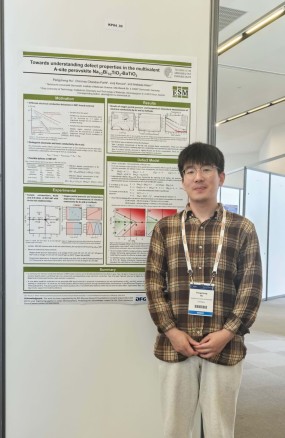
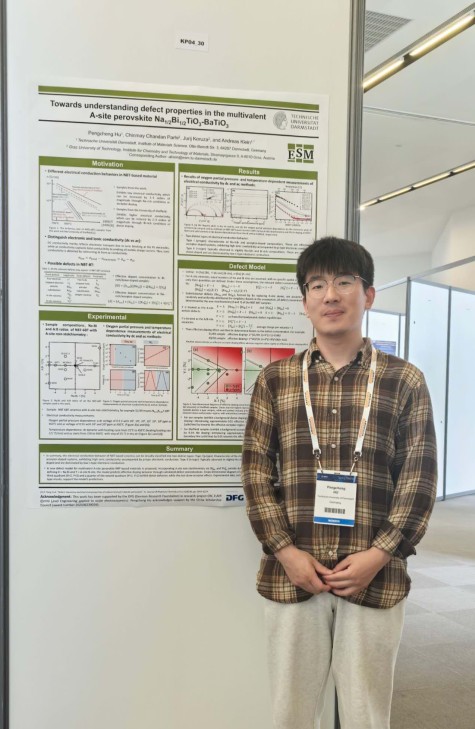
Poster Prize for Pengcheng Hu
2025/06/04
At the E-MRS Spring Meeting 2025 in Strasbourg
-
![]()
![]()
FLAIR at EMRS Spring Meeting 2025
2025/06/03
FLAIRistas Present Latest Advances of the CRC
A large number of FLAIR members participated in the E-MRS Spring Meeting 2025, which took place in Strasbourg, France from May 26 to May 30. The team, together with Mercator Fellows Elizabeth Dickey (Carnegie Mellon University, Pittsburgh) and Emre Erdem (Sabanci University, Istanbul), presented and thoroughly discussed their latest achievements with a broad international community of materials scientists focused on electroceramics. Most contributions were part of Symposium N: “Advanced Doping Strategies, Defect States, and Electronic Structure of Functional Oxides”, which was supported by FLAIR and organized by Anke Weidenkaff, Jurij Koruza, and Marc Widenmeyer. Additionally, FLAIR-related research was featured in other symposia, covering topics such as next-generation solar technologies, ferroic materials and heterostructures, solid-state ionics, anion-controlled inorganic materials and mixed-anion systems, as well as computational materials science.
Archive