Our Mission
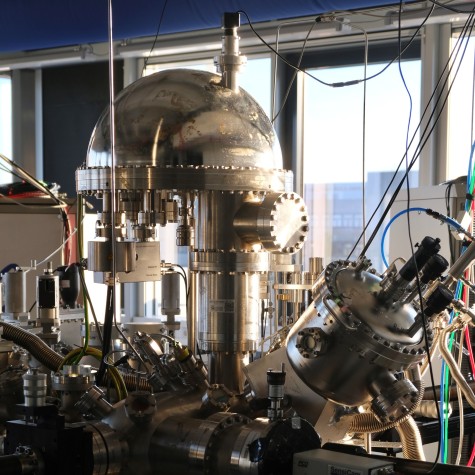
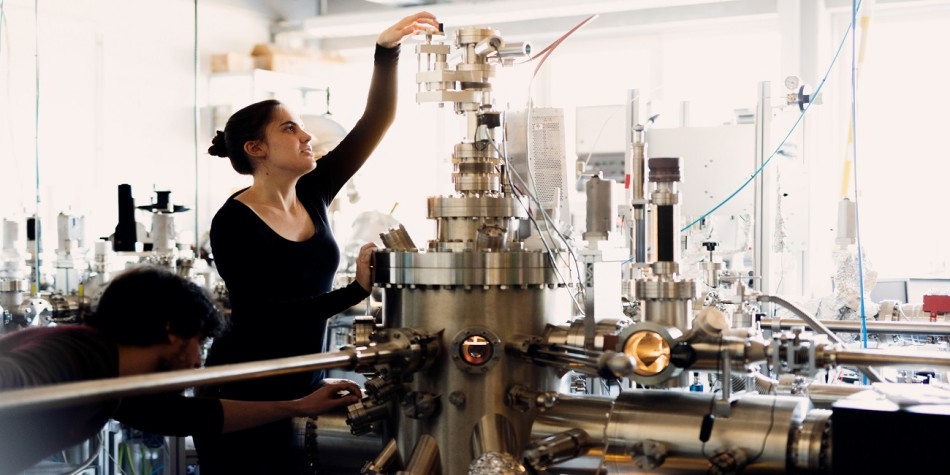
The mission of the Surface Science Laboratory is to advance the fundamental understanding of surfaces and interfaces in functional materials and devices for renewable energy conversion and storage. We study the chemical and physical processes, energetics and dynamics of processes at surfaces and interfaces of materials used in electrolysers, solar cells, and batteries. For this, we use integrated ultrahigh vacuum systems which combine different thin film preparation techniques and surface analysis tools. Next to vacuum experiments, we aim at understanding materials and devices during operation under realistic conditions using advanced spectroscopic and structural methods. Moreover, we develop novel spectroscopic approaches to unravel complex structure-property-function relationships.

Quickstart
Studies
News
-
![]()
![]()
Publication on Plasma-Engineered Hydroxyl Defects in NiO: A DFT-Supported-Spectroscopic Analysis of Oxygen-Hole States and Implications for Water Oxidation
April 15, 2026
Now online
Dr. Harol Moreno Fernández, in collaboration with Dr. Mohammad Amirabbasi from the FG Material Modeling at TU Darmstadt, and in close collaboration with Crizaldo Mempin, Jr. from the Dutch Institute for Fundamental Energy Research, Dr. Garlef Wartner and Dr. Marc F. Tesch from the Max Planck Institute for Chemical Energy Conversion, and Dr. Esmaeil Adabifiroozjaei and Prof. Leopoldo Molina-Luna from the Advanced Electron Microscopy Division at TU Darmstadt, report how plasma-assisted synthesis can be used to tailor hydroxyl defects, Ni vacancies, and oxygen-hole states in NiO thin films relevant to the oxygen evolution reaction. Combining DFT+U with advanced spectroscopy and electrochemical analysis, the study shows that oxygen-rich plasma conditions stabilize vacancy-related ligand-hole states and enhance Ni–O covalency, whereas H2O incorporation promotes local hydroxylation, modifies near-valence-band states, and facilitates transformation toward the OER-active NiOOH phase. These findings establish a plasma-controlled strategy to predefine defect configurations and catalytic functionality in Ni-based oxide thin films.
-
LEAF certification for the Surface Science Laboratory
April 02, 2026
Bronce-level certification for sustainability and efficiency measures
Efforts for reducing the environmental impact of our laboratory infrastructure were rewarded with the Bronce-level LEAF certification.
-
![]()
![]()
Redox chemistry of LiCoO2, LiNiO2, and LiNi1/3Mn1/3Co1/3O2 cathodes: Deduced via XPS, DFT+DMFT, and charge transfer multiplet simulations
January 27, 2026
Now online
Dr. Maximilian Mellin, fresh doctor from the SSL studied how the electronic structure of Li–transition-metal oxide cathodes evolves during lithium removal during charging, a key process governing battery performance.